
The densest matter we can observe
A neutron star is born when a giant star, much more massive than our Sun, explodes as a supernova. Its core collapses in less than a second into a sphere about 20 kilometers across — the size of a city — holding up to twice the mass of the Sun.
Gravity crushes the atoms themselves: electrons merge with protons, leaving almost nothing but neutrons packed together. According to NASA, one teaspoon of this matter would weigh about a billion tons on Earth. Its surface gravity is more than one hundred billion times that of Earth.
Pulsars: cosmic lighthouses
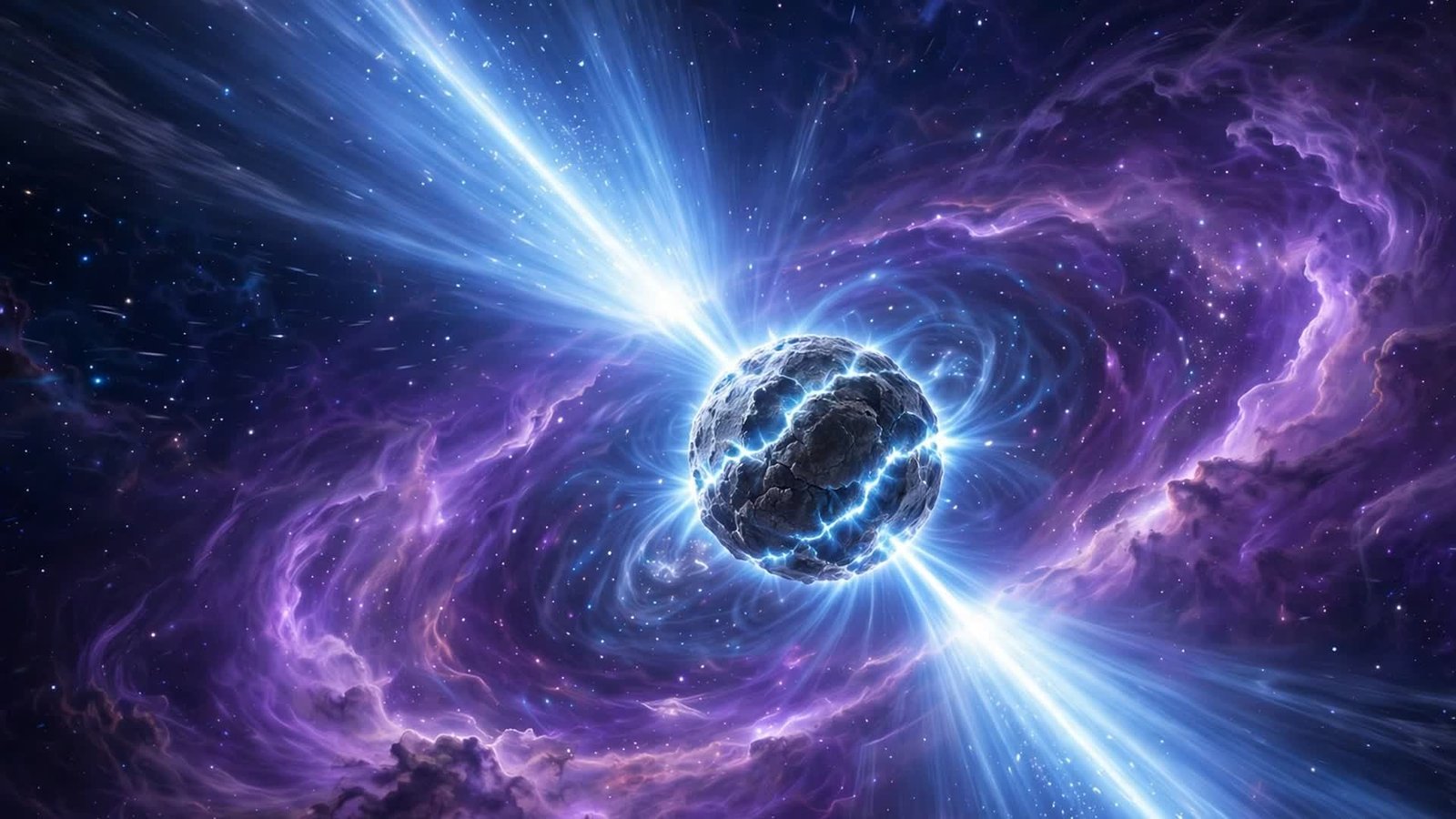
When a neutron star spins, it beams radio waves from its magnetic poles, like a lighthouse. Each sweep of the beam past Earth produces a regular pulse: that is a pulsar.
The first was discovered on November 28, 1967, by Jocelyn Bell Burnell and Antony Hewish — a steady signal, one pulse every 1.33 seconds. The speed record belongs to PSR J1748-2446ad, found in 2006 in the Terzan 5 cluster: it spins 716 times per second, its equatorial surface moving at about a quarter of the speed of light.
Magnetars: the most powerful magnets in the Universe
Some neutron stars, the magnetars, have a magnetic field up to a thousand trillion times stronger than Earth’s. When that field snaps, it releases in a fraction of a second more energy than the Sun produces in 100,000 years.
Why scientists study them
Since 2017, NASA’s NICER mission, aboard the International Space Station, has measured neutron stars precisely in X-rays. That same year, the LIGO and Virgo detectors caught the gravitational waves of two merging neutron stars (GW170817) — a collision that produced gold and platinum. The gold we wear may come from a collision just like that one.
And if a neutron star grows too heavy — beyond about twice the Sun’s mass — even neutron pressure cannot hold it up: it collapses and becomes a black hole.
▶️ Watch the video on YouTube: https://www.youtube.com/watch?v=nEtnKkIFqEM
🌐 www.universfascinant.com
Sources: NASA (NICER mission), Astronomy.com, Science (Hessels et al., 2006).